09 December 2025
A new visual identity for MASEREEL

Interview with graphic designer Remco van Bladel
At the beginning of March 2025, we launched not only a new name but also a brand-new visual identity. It’s high time to introduce you to the designer behind this successful makeover. We spoke with designer Remco van Bladel about typography, the role of our surroundings in the graphic design, and how openness and closure found their form in our new identity.
Remco van Bladel graduated in 2002 from the Graphic Design department at St. Joost in Breda. In 2006, he co-founded the publishing house Onomatopee with Freek Lomme, creating a platform for exhibitions and publications at the intersection of (sound) art, poetry, and visual culture. This period served as an important testing ground for his experiments with book design, editorial work, and publishing.
From 2011 onward, his practice shifted toward online publishing and developing web platforms for organizations such as Witte de With and e-flux. He left the publishing house to focus fully on his own design studio, working on typefaces, identities, books, websites, and large-scale installations with a strong typographic emphasis.
During the pandemic, he began a new collaboration with his partner and artist Mariana Lanari called Archival Consciousness. Together, they explore how data from libraries and archives can be made more accessible to the public. This led to the creation of Biblio-Graph.org, a web application for visualizing and searching physical and born-digital collections.
Hi Remco, what drew you to MASEREEL, and how did our organization inspire your design?
When your work involves various printing techniques, as mine does, your heart immediately beats faster when you think of a place like MASEREEL. The first time I visited Kasterlee and saw the location and all the facilities, I was instantly sold. It’s fantastic to have a place and program for artists with so much expertise and support. The rural setting is also unique and immediately became an inspiration.
You were inspired by our natural surroundings. Can you explain how this is reflected in the visual identity?
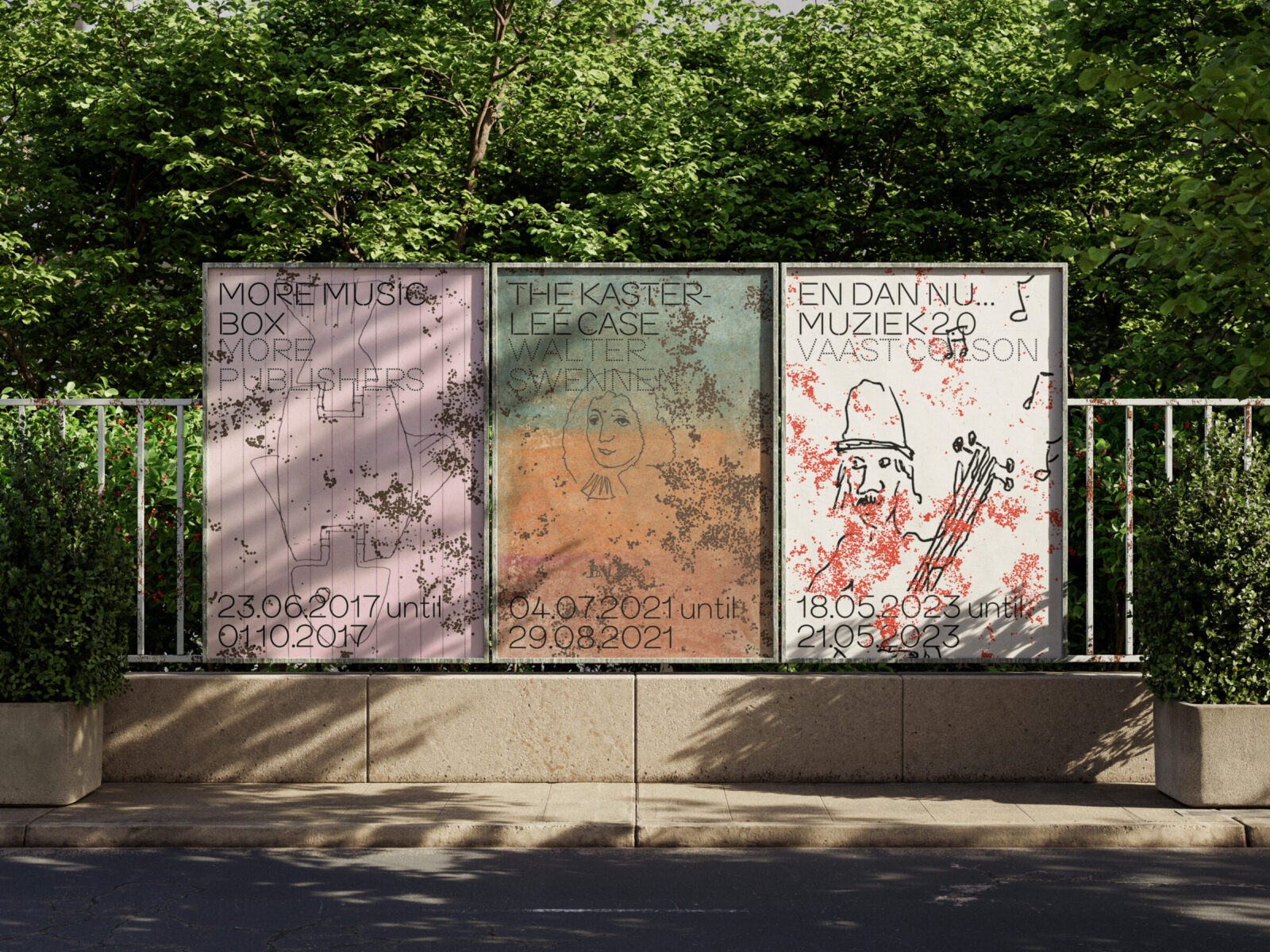
The identity consists roughly of three elements/layers. The first is the color palette, based on nature, which we use as the foundation for all applications. The second layer is typography/information. Finally, the third layer is abstract patterns. For this, we sourced and created various images of the environment and plants, converted them into ‘dots,’ and added them as a graphic top layer.
The new typeface and patterns are built from ‘dots.’ What does this design principle mean, and why is it suitable for MASEREEL?
During the briefing, it became clear that MASEREEL’s program consists of two pillars: the artistic work and the residencies. During the process, we sought a translation for both this ‘open’ and ‘closed’ character. There are public events, exhibitions, and open days, as well as periods during which residents can focus undisturbed on their work. This translated into a font composed of fine dots, which gradually become denser until they form a solid letter again.
Can you tell us about the process of developing the typeface and patterns? Which choices were exciting or challenging?
We started the process with various studies around typography, exploring how the character could be open or closed. For the letters, we experimented with different structures and shading, which were gradually simplified into the dotted lines.
At the same time, we focused on the wordmark, particularly due to the transition from Frans Masereel Centrum to MASEREEL, while still wanting to retain the circle as a central shape. This resulted in a proposal with two half-circles around MASEREEL that could be placed open or closed. It felt a bit flat and one-dimensional. By adding landscape photography in the same dotted style as a layer, we created more depth and layering in the basic layout.
Are there small details or subtle elements in the identity that you’re particularly proud of?
I think we are most proud of the entire font and the details incorporated into it. What started as an idea for shading from various graphic techniques gradually became a unique typeface in three versions. Even the closed form features small ‘openings’ in the capital letters that disappear when the letter is small but become visible when the typography is used at a monumental scale. Finally, we also created an italic version.
How did you ensure the design is flexible for different applications, such as online, print, and merchandise?
By keeping the foundation simple, I think. We start from the format and grid, plus the three layers: color (palette) + type + pattern, which can be combined in endless variations. We created dozens of patterns in different color schemes, allowing a MASEREEL design to be quickly applied regardless of format or medium.
What message or feeling do you hope people get when they encounter our new visual identity?
That’s a tough question! It naturally depends on the audience, whether a visitor or a potential resident, but in general, I hope the identity first sparks curiosity and invites people to explore what MASEREEL is and what they can do and see here. The contemporary character, a lively program illustrated by the patterns referencing both printing techniques and the surrounding environment, the rural setting translated into hundreds of small dots, and the playful type that can be both ‘open’ and ‘closed.’
We are very happy with the result!
More info: Studio Remco van Bladel